
NX40 Module Handling
NX40 is an LGA surface-mount module. Use ESD, moisture, placement, and thermal-process controls appropriate to the released production specification.
Production status: The supplied draft does not contain sufficient module qualification evidence to publish MSL, floor-life, baking, reflow, and tape-and-reel values as approved NX40 production limits.
Receiving and Storage
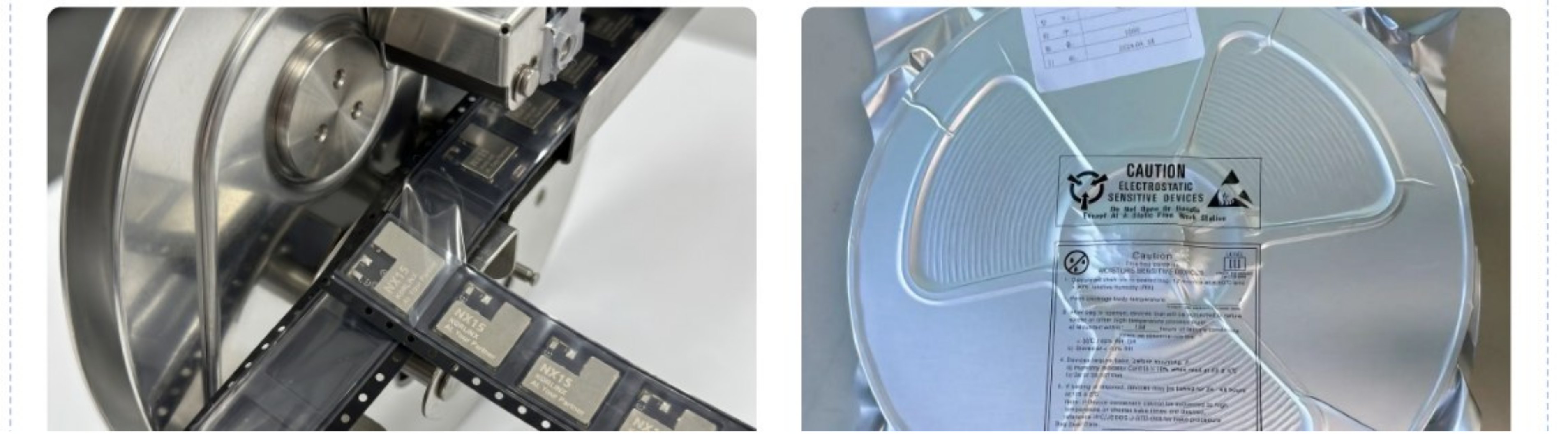
The photograph is reproduced from the complete review draft. It illustrates the packaging format; it does not approve the printed MSL information or packing limits.
Draft Source Values
These values are retained from the original datasheet for review. Use the release requirement column to determine what must be confirmed before production.
| Item | Draft source value | Release requirement |
|---|---|---|
| Module MSL | MSL 3 | Confirm with the NX40 module-level J-STD-020 classification report |
| Floor life | ≤168 hours at <30°C / <60% RH | Publish only after MSL 3 approval |
| Shelf life | 12 months from shipment | Confirm packaging, barrier bag, desiccant, and HIC process |
| Baking | 125°C for 24 hours | Confirm component limits, carrier compatibility, and J-STD-033 procedure |
| Unopened storage | 5–35°C, 20–70% RH | Confirm controlled warehouse and warranty conditions |
Before production, obtain the approved values for:
| Control | Required release information |
|---|---|
| Moisture sensitivity level | Approved NX40 MSL classification and governing standard |
| Shelf life | Duration and sealed storage temperature/humidity |
| Floor life | Time, temperature, and humidity after opening |
| Baking | Trigger, temperature, duration, tray/reel limitation, and maximum cycles |
| Packaging | Moisture barrier bag, desiccant, humidity indicator, and label content |
Handling Guidelines
- Use an ESD-controlled workstation and grounded handling equipment.
- Keep modules in approved moisture-barrier packaging until assembly.
- Avoid touching or contaminating the LGA pads.
- Inspect the shield, antenna area or RF connector, package edges, and pads before placement.
- Pick up the module with an approved vacuum nozzle on the top surface.
- Avoid mechanical load on the shield, chip antenna, and external-antenna connector.
- Track the lot, package-open time, exposure condition, and bake history.
Reflow Soldering
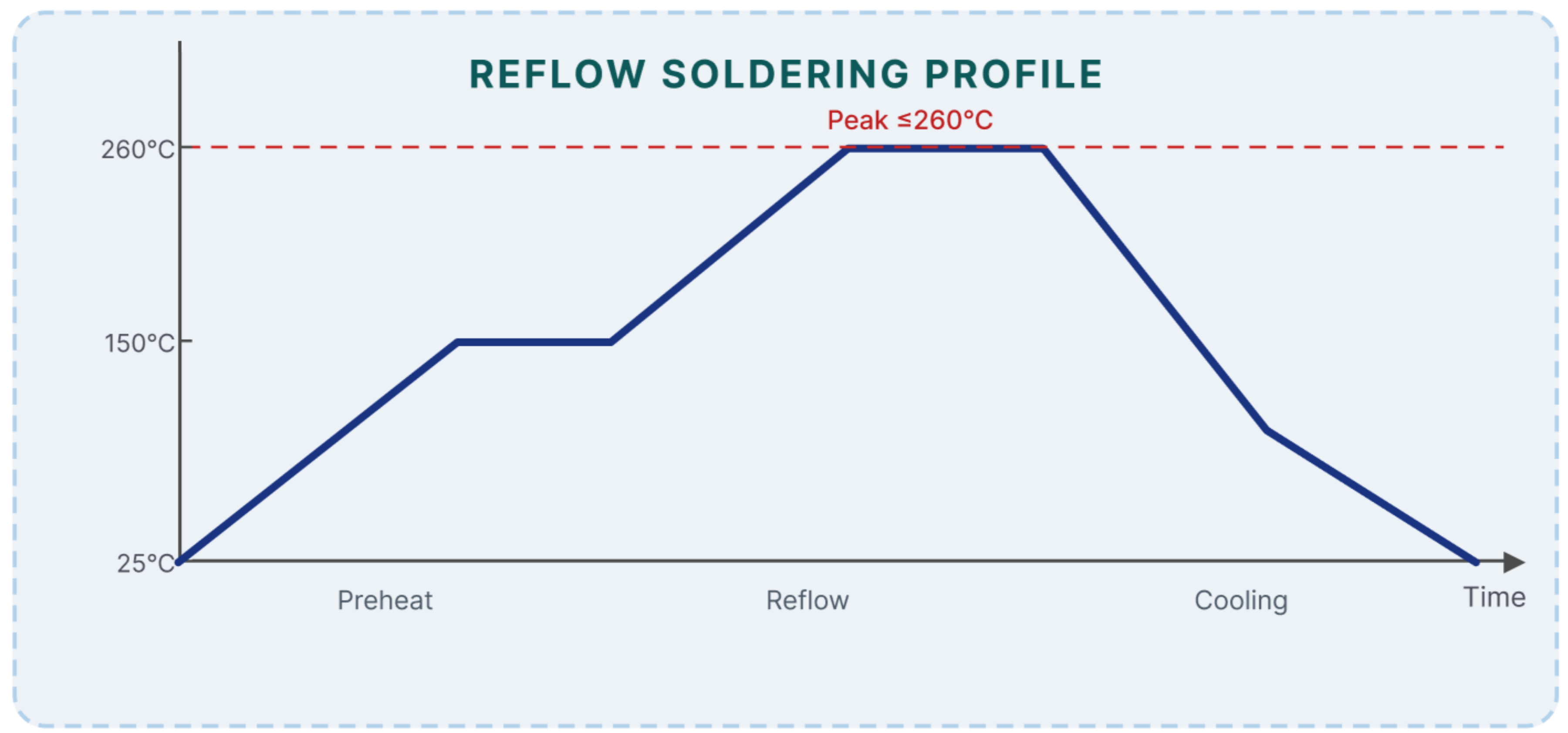
The diagram is reproduced from the complete review draft. Its ≤260°C label remains a draft value until confirmed by NX40 module and assembly qualification.
The production reflow profile must be based on the approved NX40 assembly qualification and the final PCB thermal mass, paste, stencil, component density, and oven.
| Profile item | Draft source value | Required controlled value |
|---|---|---|
| Ramp-up rate | Not specified | Pending process approval |
| Preheat / soak | 150–200°C for 60–120 seconds | Pending qualified profile |
| Time above liquidus | Not specified | Pending process approval |
| Peak package temperature | ≤260°C | Pending module qualification |
| Time within 5°C of peak | Not specified | Pending process approval |
| Ramp-down rate | <6°C/s | Pending process approval |
| Maximum reflow cycles | 2 | Pending module qualification |
Do not use the nRF52840 package limit alone as the NX40 module reflow specification.
Cleaning
Do not use ultrasonic cleaning or liquid immersion unless the process has been validated for the complete module. Confirm flux compatibility and residue requirements with the EMS/SMT process owner.
Tape and Reel
Carrier-tape dimensions, pocket orientation, pitch, reel diameter, quantity per reel, leader/trailer lengths, cover-tape peel force, and label fields remain subject to the approved packing drawing.
Production Checklist
| Check | Confirmation |
|---|---|
| Incoming material | Correct model, lot, packaging condition, and exposure history |
| Footprint | Released land pattern, orientation, courtyard, and paste aperture |
| Moisture control | Approved MSL, floor life, storage, and bake procedure |
| Thermal process | Approved profile and allowed cycle count |
| Placement | Qualified nozzle, force, position, and rotation |
| Inspection | Joint quality, alignment, shield, antenna/connector, and contamination |
| Traceability | Lot, oven profile, exposure time, rework, and inspection records |