
AS-611Bn Command and Data Reference
This page condenses the command and frame information in the supplied manual. All commands are lowercase ASCII.
Firmware-specific reference This page follows the supplied manual marked Ver.4.0 Jun.2026. Confirm command support for the installed function and firmware. Commands are shown without a terminator because the manual does not specify one. Examples are documented syntax, not captured transactions.
Common commands
| Command | Example | Documented default/range | Function |
|---|---|---|---|
mode | mode 1 | Default 1; 1 or 2 | 1: distance, 2: vital sign |
start | start | — | Start data output |
stop | stop | — | Stop data output |
baud | baud 460800 | Default 460800; 115200, 230400, 460800, 921600 | Save baud rate and reboot |
reset | reset | — | Software reset and reinitialize current mode |
freset | freset | — | Hardware/cold reset; factory-default restoration is not specified |
test | test 0 | Default 0; 0 or 1 | Normal or test/debug wave output |
Documented mode responses:
=DISTANCE!
=VITAL!
Distance-mode commands
| Command | Example | Default | Range | Function |
|---|---|---|---|---|
zmin | zmin 25 | 25 cm | 10 to zmax - 25 cm | Minimum range |
zmax | zmax 300 | 300 cm | 50–2000 cm | Maximum range |
pmode | pmode 0 | 0 | 0, 1, 2 | Balanced, fast, accurate |
sena | sena 50 | 50% | 0–100% | CFAR sensitivity |
sort | sort 0 | 0 | 0, 1 | Distance-first or strength-first |
outtime | outtime 1 | 1 | 0, 1 | 0: documented 15 Hz; 1: once per second |
Vital-mode commands
| Command | Example | Default | Range | Function |
|---|---|---|---|---|
zmin | zmin 25 | 25 cm | 15 to zmax - 25 cm | Minimum vital-sign range |
zmax | zmax 150 | 150 cm | 40–250 cm | Maximum vital-sign range |
wave | wave 1 | 0 | 0, 1 | 0: simple, 1: waveform |
exten | exten 1 | 0 | 0, 1 | 0: no HRV extension, 1: add RMSSD and SDNN |
Distance frame
#ABBBBCCC!
| Segment | Width | Meaning |
|---|---|---|
# | 1 | Start |
A | 1 | Object index |
BBBB | 4 | Distance, cm |
CCC | 3 | Reflected strength |
! | 1 | End |
Example: #10250045! = object 1, 250 cm, strength 45.
No target: #0! every 15 seconds.
Vital state
| Value | Meaning |
|---|---|
0 | No target |
1 | Target moving |
2 | Target calculating |
3 | Vital-sign result |
Simple vital frame
%ABBBCCDDD!
| Segment | Width | Meaning |
|---|---|---|
% | 1 | Start |
A | 1 | State |
BBB | 3 | Heart rate per minute |
CC | 2 | Breathing rate per minute |
DDD | 3 | Distance, cm |
! | 1 | End |
Rate: once per second.
Extended simple frame:
%ABBBCCDDEEFFF!
DD: RMSSD ms; EE: SDNN ms; FFF: distance cm.
Waveform vital frame
@ABBBCCDEEEFFF!
| Segment | Width | Meaning |
|---|---|---|
@ | 1 | Start |
A | 1 | State |
BBB | 3 | Heart rate per minute |
CC | 2 | Breathing rate per minute |
D | 1 | Heart-beat pulse: 1 at each beat, otherwise 0 |
EEE | 3 | Respiration waveform, 0–999 |
FFF | 3 | Distance, cm |
! | 1 | End |
Rate: 10 frames per second.
Extended waveform frame:
@ABBBCCDDEEFGGGHHH!
DD: RMSSD ms; EE: SDNN ms; F: heart pulse; GGG: respiration waveform; HHH: distance cm.
No target: %0! or @0! every 15 seconds.
Frame lengths and unresolved encoding
The lengths below are calculated from the literal ASCII layouts, including start and end markers and excluding any additional transport terminator.
| Format | Layout-derived length | Manual's length label |
|---|---|---|
| Distance | 10 bytes | 10 bytes |
| Simple vital | 11 bytes | 10 bytes — inconsistent |
| Extended simple vital | 15 bytes | Not stated |
| Waveform vital | 15 bytes | 14 bytes — inconsistent |
| Extended waveform vital | 19 bytes | Not stated |
Use these as candidate layouts, not firmware-verified packet lengths. Capture actual output for every wave/exten combination before enforcing a strict parser. The manual also leaves these details undefined:
- Encoding of object 10 in the one-character object-index field, grouping of multiple target frames, and the meaning of a complete 15 Hz cycle.
- Numeric padding, overflow, signedness, rounding, and invalid/unavailable sentinels.
- RMSSD/SDNN values above 99 ms and the time window used to calculate HRV.
- Command echoes, most acknowledgements/errors, response timeouts, and status/diagnostic frames.
Output cadence does not establish how frequently each physiological value is independently recalculated. Moving/calculating states must not be treated as confirmed vital-sign measurements.
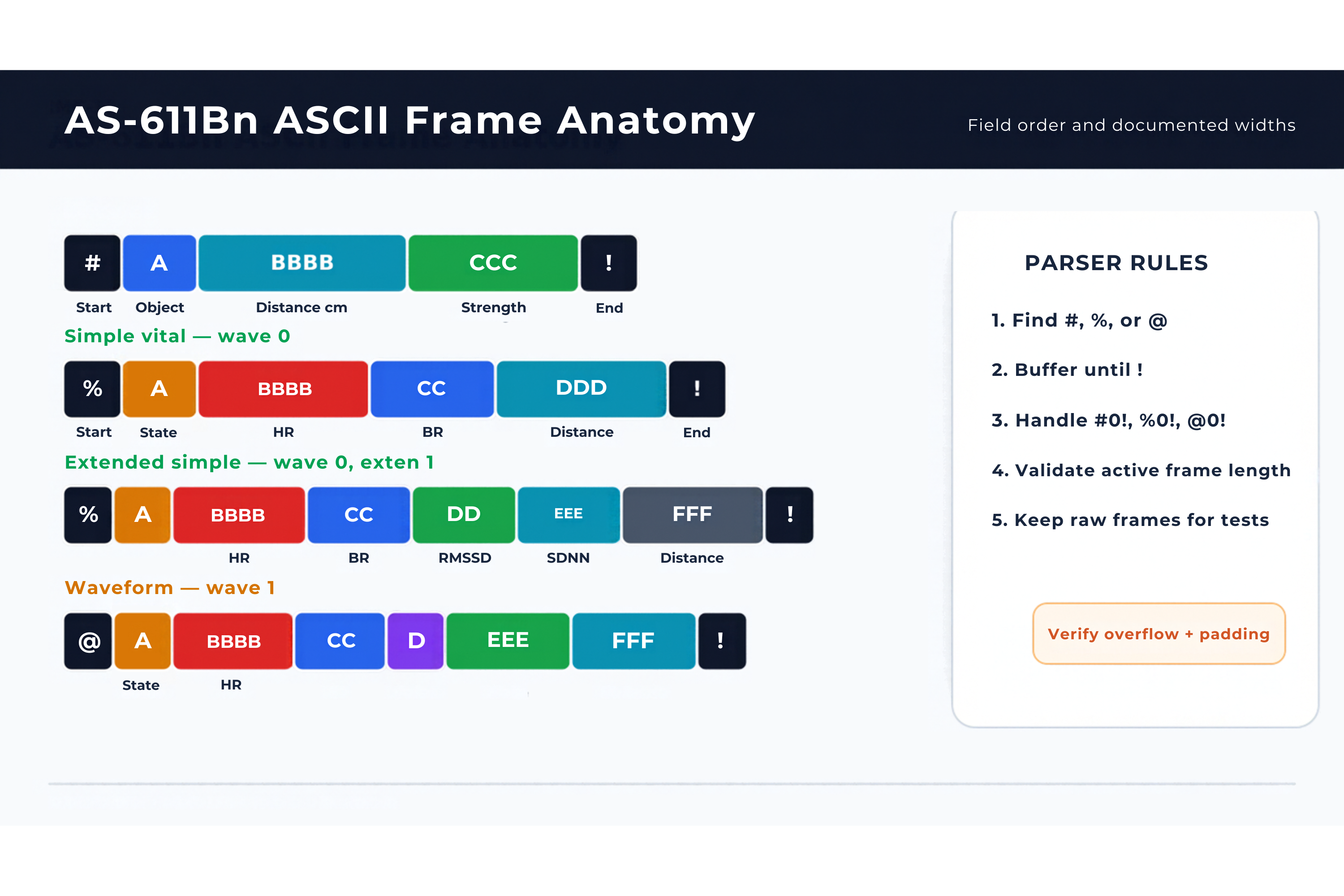
Parser requirements
The following are host-integration recommendations, not extra device commands:
- Separate measurement markers (
#,%,@) from documented mode replies (=DISTANCE!,=VITAL!) and boot/status messages. Preserve unknown echoes or errors for inspection. - Buffer partial messages through
!, while enforcing a host buffer limit and a timeout chosen for the tested connection. Recover from an incomplete or malformed message at a recognized boundary; never wait indefinitely. - Handle
#0!,%0!, and@0!before fixed-width measurement parsing. Recognize the boot banner separately. - Validate lengths and field encodings against raw captures for the active mode,
wave, andextensettings. Do not silently truncate a value or invent an object-10 encoding. - Treat only state
3as an available vital-sign result. Keep moving/calculating and unavailable fields distinct from measured zero values. - Allow multiple frames in one UART read or BLE notification and one frame across multiple reads/notifications.
- After a mode change or reboot, discard incomplete old measurement frames and establish the current configuration before decoding new data.
- Timestamp and retain raw frames, configuration, and firmware version during validation.
Boot frame
The manual documents:
#AS_611B_4.0!
Do not parse this as distance data. Detect the prefix or validate the distance-frame length before numeric conversion.